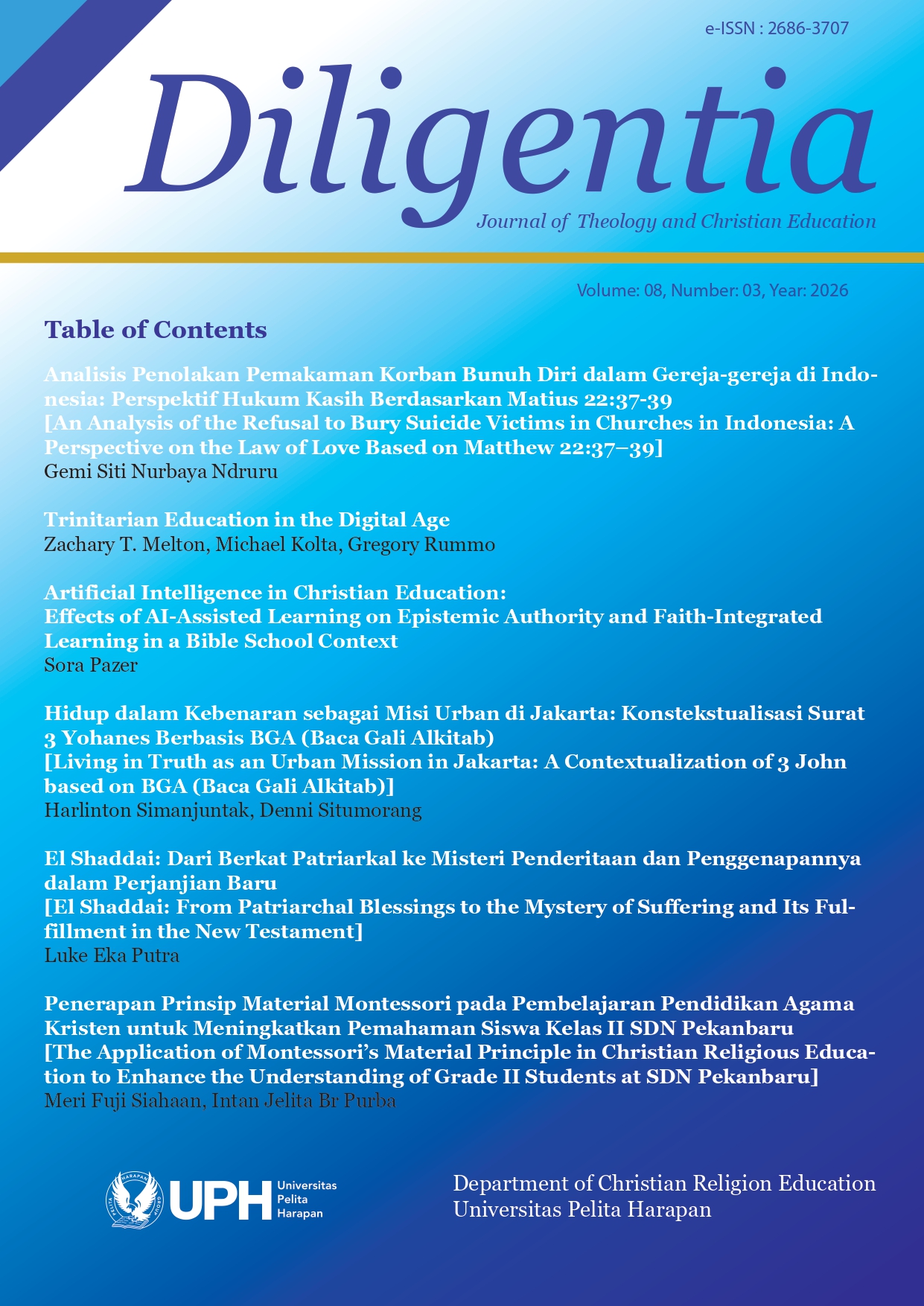
Dr. Michael Kolta has co-authored a new research paper titled "Trinitarian Education in the Digital Age," published in the September 2026 issue of Diligentia: Journal of Theology and Christian Education.
The paper, written alongside Zachary T. Melton and Gregory Rummo, explores the intersection of Christian theology, classical education, and artificial intelligence (AI), examining how ancient wisdom and traditional educational principles can guide the responsible use of modern technology in teaching and learning.
Connecting Classical Thought with Modern Technology
Drawing on the writings of influential Christian thinkers, including St. Augustine of Hippo and C.S. Lewis, the research incorporates Dr. Kolta's work on the ethical implications of computers, software, and artificial intelligence.
The paper's first author, Zachary T. Melton, brings these perspectives together to develop an innovative framework connecting Trinitarian theology with the classical educational model known as the Trivium, consisting of Grammar, Logic, and Rhetoric.
Through this interdisciplinary approach, the authors examine how AI can support education while preserving essential human qualities such as memory, understanding, critical thinking, and love.
Faith, Education, and the Future of AI
As artificial intelligence becomes increasingly integrated into education, the paper emphasizes the importance of ensuring that technology enhances rather than diminishes human learning and development.
The research highlights how Christian principles and classical educational traditions can provide meaningful guidance for educators navigating the opportunities and ethical challenges of AI.
This publication reflects Dr. Kolta's continued commitment to exploring the relationship between faith, technology, ethics, and education, building upon themes addressed in his book, Christian Ethics in Computers, Software, and Artificial Intelligence.
Read the Published Paper
The full research paper is available through Diligentia: Journal of Theology and Christian Education, Volume 8, Number 3 (2026), pages 219–234.